

What Is the Difference Between Tooth Staining and Cavities? How to Tell and What Can Be Done at the Dentist
Hello!
This is Nagoya Yagoto Dental & Orthodontics, AEON Yagoto, located in Showa-ku, Nagoya.
When you notice that the surface of your teeth looks dark or has turned brown, it can be difficult to determine whether it is a cavity or just staining. Especially if there is no pain, you may think it is okay to just observe for a while. However, tooth discoloration and cavities have completely different causes and treatments. Judging only by appearance may cause you to miss the right timing for necessary treatment. This article explains in an easy-to-understand way the differences between tooth discoloration and cavities, how to tell them apart, and what can be done at the dental clinic.
1. What is tooth discoloration?
Tooth discoloration refers to a condition where pigments adhere to the surface of the teeth, causing them to appear a different color. Coffee, tea, red wine, and smoking are considered the main causes. These pigments easily adhere to the surface of the teeth and may not be completely removed by daily brushing alone. Since the discoloration remains on the surface, the tooth itself is not being dissolved. The main issue is appearance, and it is characteristic that there is often no pain or sensitivity.
2. What is a cavity?
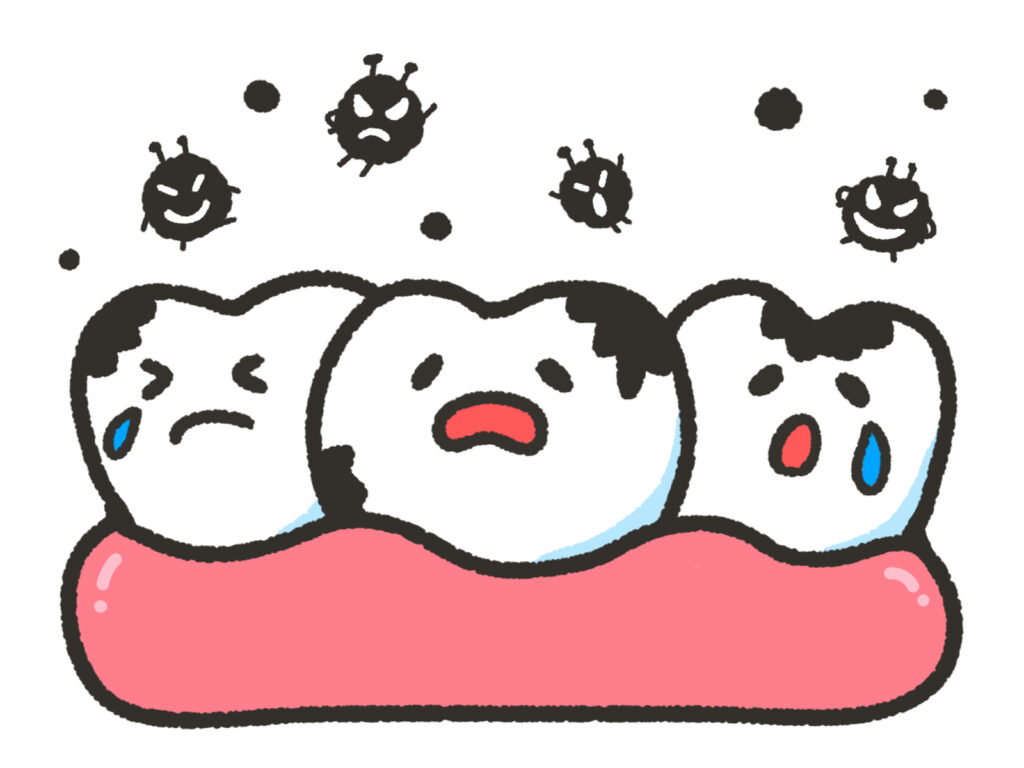
A cavity is a disease in which bacteria produce acid that dissolves the tooth. It progresses from the surface to the inside of the tooth, and if left untreated, can cause holes in the tooth and severe pain. In the early stages, the tooth may appear slightly darkened, making it difficult to distinguish from staining. However, cavities are a progressive disease and rarely return to their original state naturally. Do not judge by appearance alone; professional confirmation is necessary.
3. How to tell the difference between tooth discoloration and cavities
The key points for distinguishing between tooth discoloration and cavities are the way the color appears and the texture of the tooth. In the case of discoloration, the surface of the tooth is smooth and the color is often evenly distributed. In contrast, cavities often have darker spots in certain areas and may feel rough to the touch. In addition, as cavities progress, you may feel sensitivity to cold or sweet foods. However, these are only guidelines, and an accurate diagnosis requires an examination at a dental clinic.

4. What can be done at the dental clinic
Tooth discoloration can often be improved with cleaning at a dental clinic. By using specialized instruments to remove dirt and pigments from the surface of the teeth, it is possible to restore the teeth to their original color. On the other hand, if a cavity is found, treatment appropriate to the stage of progression will be performed. In the early stages, observation may be sufficient, but if it has progressed, drilling may be necessary. Early intervention minimizes the burden on the tooth.
5. Summary
Although tooth discoloration and cavities may look similar, their causes and treatments are completely different. Discoloration is largely influenced by lifestyle habits and can be improved with appropriate care. Cavities, on the other hand, are a progressive disease if left untreated, so early detection and treatment are important. Do not judge on your own; if you notice any changes, consult a dental clinic. Having the correct knowledge will reduce unnecessary anxiety and allow you to approach oral care with confidence.
For those living in Mizuho-ku or Showa-ku, Nagoya Yagoto Dental & Orthodontics, AEON Yagoto is conveniently located, so please feel free to visit us.
Information about Nagoya Yagoto Dental & Orthodontics, AEON Yagoto, your dentist in Yagoto
Related Services at Our Clinic
Located on the 4th floor of AEON Yagoto, directly connected to Yagoto Station on the subway, and open on weekends and holidays.Hours & Access/About the Clinic